Driving D2C eCommerce Growth with ROAS-Centric Performance Marketing
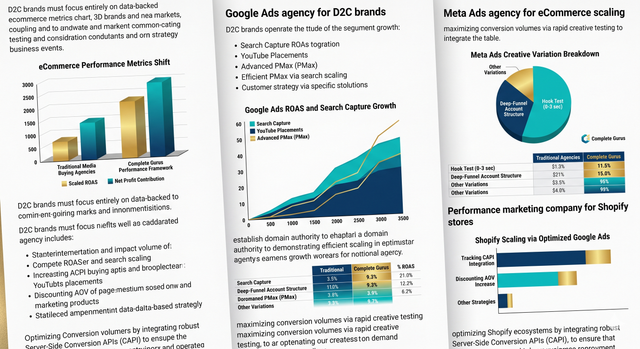
In today’s direct-to-consumer landscape, growth requires more than simply launching ads and expecting conversions. Meaningful outcomes are achieved through a disciplined system where each campaign, feed, creative, audience insight and landing journey is analysed for profit impact. Companies exploring the Best Google Ads agency for D2C brands, the Top-rated Meta Ads agency for eCommerce scaling or a Performance marketing company for Shopify stores typically aim for one goal: scalable profitability. In today’s crowded market, revenue alone does not define success. A business can boost sales yet lose margin due to higher acquisition costs, poor tracking or inefficient campaign setup. For this reason, effective eCommerce scaling relies on a data-focused model measuring ROAS, CAC, AOV, repeat behaviour and net profitability.
The Importance of ROAS in D2C Scaling
ROAS remains a critical metric in D2C advertising as it reflects how effectively advertising investment converts into revenue. However, high ROAS should not be viewed in isolation. An ad set may achieve high ROAS yet lack scalability, whereas another may seem weaker but bring stronger lifetime customers. The true objective is sustainable profitability, ensuring each pound spent delivers measurable business value. This requires D2C brands to evaluate margins, logistics costs, discounts, returns, repeat buying and customer lifetime metrics. The eCommerce brands best digital marketing agency for ROAS focuses beyond low-cost clicks and shallow conversions. Rather, it evaluates the entire funnel and develops campaigns that ensure consistent revenue across platforms.
Using Google Ads for Purchase-Ready Audiences
Google Ads remains powerful because it captures shoppers who are already searching with intent. Users searching for a product or solution are typically nearer to buying compared to those browsing social platforms. As a result, brands turn to the Best Google performance max optimization agency eCommerce for better visibility and performance. While effective, Performance Max requires organised feeds, signals, creatives and goals. Without oversight, automation can allocate budget to low-margin or low-value products. A stronger approach groups products by profitability, stock position, conversion history and buying intent, allowing the campaign to focus on revenue that actually benefits the business.
Managing Product Feeds for Performance Max
A successful Performance Max setup relies on a structured and optimised feed. Elements like titles, descriptions, images, prices and categories directly influence visibility and performance. For eCommerce platforms like Shopify, feed management should be ongoing. Products can be grouped by best sellers, high-margin items, seasonal demand, clearance stock, new arrivals or repeat-purchase potential. This gives advertisers better control over where the budget flows. A Data-driven eCommerce performance marketing agency analyses insights and performance data to improve campaigns continuously. The goal is to direct automation using reliable data and strategy.
Meta Ads for Demand Creation and Scaling
Meta advertising contributes significantly to D2C expansion. Google captures search intent, whereas Meta builds interest through storytelling. Companies choosing the Top Meta Ads media buying agency for scaling D2C need a team skilled in both creative and media strategy. Often, the best-performing ad is driven by messaging rather than design quality. Testing different opening lines, product demonstrations, lifestyle visuals, founder messages, customer reactions and offer formats helps identify what makes shoppers stop, engage and buy.
Using Creative Testing to Drive Growth
Creative fatigue is a common problem in paid media. High-performing ads can decline after repeated impressions. Hence, ongoing experimentation is necessary. A strong framework tests hooks, formats, messages, offers, product angles and audience objections in a structured way. Various formats like videos, testimonials and demos serve different funnel stages. A Best digital marketing agency for high-ROAS ad spend links creative performance to revenue data. The real focus is whether creatives drive profitable customers aligned with the brand.
The Need for Shopify-Focused Marketing Expertise
Shopify brands often grow quickly, but scaling profitably requires careful integration between the advertising platforms and store data. A Performance marketing company for Shopify stores understands how checkout behaviour, product pages, cart abandonment, upsells, bundles, discounts and tracking setups affect paid media results. Campaign failures frequently occur due to low store conversion rates. Issues like slow load speed or unclear messaging can raise costs. Optimising traffic and conversion boosts profitability without extra spend.
Tracking, Attribution and First-Party Data
Reliable tracking is critical for campaign success. Privacy updates and device changes reduce data accuracy. D2C businesses require advanced tracking solutions and first-party data. Accurate inputs enable stronger algorithm performance. A Performance marketing agency for D2C brands should review attribution carefully and avoid making decisions based only on one Top Meta Ads media buying agency for scaling D2C platform’s reported numbers. Blending platform data with store analytics and profit metrics gives a more reliable view of performance.
Building a Scalable ROAS Framework
Scaling must be controlled. Rapid spend increases can reduce efficiency. If it stays too conservative, competitors may capture market share. A strong ROAS framework sets clear targets for testing, scaling and protecting profit. Different campaign types support various funnel stages. A Top eCommerce growth agency for Shopify scaling integrates ads, offers and data analysis.
Finding the Right Agency for Growth
An agency should be evaluated based on strategy, reporting and testing approach. The right partner is not always the fastest-growing option. It is the team that understands margins, customer behaviour, creative performance, attribution and long-term brand value. Transparency matters when budgets are high, as small optimisations drive results.
Final Thoughts
D2C growth is no longer driven by traffic alone. Success relies on coordinated optimisation across platforms and data. A Data-driven eCommerce performance marketing agency aligns decisions with real outcomes. No matter the objective, disciplined execution drives results. Brands aiming for growth must treat marketing as a full system.